
Newsletter Subscribe
Enter your email address below and subscribe to our newsletter

 ByJohn A
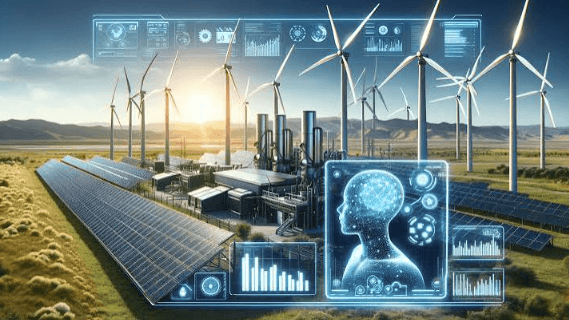
AI is transforming renewable energy by improving forecasting, reliability, and grid management through integrated weather, market, and asset data. This approach quantifies uncertainty, enhances risk-informed planning, and supports auditable, real-time operations. The emphasis on governance, standards, and scalable architectures aims for policy-aligned investments and trustworthy delivery. As performance metrics become more transparent and interoperable, stakeholders confront how to balance costs, resilience, and decarbonization—advancing decisions that shape the next phase of the energy transition.
Advances in artificial intelligence are reshaping how renewable energy systems forecast output and maintain reliability. AI enhances Forecasting resilience by integrating weather, market signals, and asset data to improve Demand forecasting; it quantifies Forecast uncertainty, enabling risk-informed planning.
Models supporting grid dependability reduce outages, guide investment, and empower policy makers seeking freedom through transparent, data-driven reliability benchmarks and proactive system design.
Building on prior work in forecasting and reliability, AI-enabled grid operations integrate live data streams from generation assets, weather sensors, demand signals, and market prices to optimize decision-making in real time.
The approach emphasizes AI governance and data standards to ensure transparent, auditable control, resilient interfacing, and accountable responses, guiding policy, market design, and infrastructure upgrades toward adaptable, trustworthy grid management.
Efficient storage dispatch and resource allocation leverage machine learning to balance supply and demand across temporal scales, optimizing charging/discharging schedules, capacity utilization, and asset sequencing under evolving price, reliability, and policy constraints.
The discussion emphasizes storage governance, dispatch optimization, and data-driven decision frameworks, enabling transparent performance metrics, risk-aware planning, and policy-aligned investments that support resilient, flexible energy systems and market-enabled freedom.
What does it take to move AI-enabled strategies from pilot studies to scalable, real-world deployments in renewable energy?
Real-world adoption hinges on transparent AI governance, interoperable standards, and rigorous evaluation. Data harmonization enables comparable metrics across sites, while scalable architectures support rapid deployment. Policy-aligned risk controls, public accountability, and continuous learning ensure resilient, cost-effective progress toward a freer, cleaner energy future.
Funding models for AI-enabled renewable projects rely on blended sources, including government grants, private equity, and concessional loans; grant sustainability is pursued through outcome-based subsidies, performance contracts, and collaborative funds, while risk-sharing accelerates deployment and maintains policy alignment for freedom-minded investors.
Data privacy concerns center on safeguarding consumer and infrastructure data while enabling analytics; data security requires robust governance, encryption, access controls, and incident response, with policy-driven, forward-looking frameworks that balance transparency, accountability, and user autonomy for energy systems.
AI talent shifts emerge as automation reshapes roles, with demand moving toward specialized data, governance, and systems integration; automation ethics guides transition planning, reskilling, and safety protocols, enabling informed workforce freedom while ensuring prudent, data-driven policy adaptation.
See also: AI in Renewable Energy Optimization
AI cannot guarantee 100% reliability in grids. A striking statistic: fleets of sensors reduce outages by 30%. Nonetheless, ai reliability and grid stability depend on diverse data, robust governance, and continuous monitoring, supporting freedom through resilient, data-driven policy.
Long-term maintenance costs of AI systems vary, but typically require ongoing maintenance budgeting and scalable updates; vendor support is essential for security patches and model retraining, enabling policy-driven, forward-looking risk management and autonomous system resilience for freedom-seeking stakeholders.
AI-enabled forecasting, grid operations, and storage optimization are reshaping renewables with transparent metrics and interoperable standards. Data-driven insights inform policy, investment, and risk management, enabling auditable, resilient energy systems. As continuous learning and governance mature, cost-effective, scalable solutions will expand reliability and integration across markets. Will decision-makers seize this opportunity to codify trustworthy AI pathways that accelerate a cleaner, more resilient energy future?



[…] See also: AI in Renewable Energy […]